Read eBooks straight from your netbook!

There are a number of ways to access eBooks from the school’s ePlatform. One of the easiest ways is straight from your netbook with the platform’s built in reader.

How?

1. Go to: https://hopcross.wheelers.co/

2. Find the book that you want to borrow.

3.  Click ‘Login to borrow this title’.

ePlatform


3. Click the ‘Read now’ button.

This process will open the book in the reader. Once you have opened the book once in this way, you can continue to read the book offline by returning to the same URL so make sure you bookmark it so you can find it again.

Posted in eBooks | Leave a comment

Locate a comma to separate items in a list

This post is part of a series relating to the Minimum Standards for Grammar and Punctuation in the NAPLAN tests. For the first post in this series, click here.

At Year 7 level, the students are expected to be able to:

  • locate a comma to separate items in a list

This one is relatively simple as it only asks the student to use commas correctly in a list. The rule here is pretty straight forward: commas are used to separate items in a list. Such as:

You need to bring your sleeping bag, torch, compass and some snacks to camp.

or

Things to bring to camp: sleeping bag, torch, compass and some snacks.

The Example Test

To complicate matters, the example test has one question about a list – but not comma placement – and two about comma placement – but not in lists. As a result, it might be beneficial to you and your students to familiarise yourself with all of the rules about comma placement – and colon use as well for that matter.

Once you’ve got the hang of the rules, you can test yourself with the Eats, Shoots and Leaves book tie-in game, Save the Comma.

Back

Posted in Grammar, NAPLAN, Punctuation | 1 Comment

Identify the phrase required to complete a sentence

This post is part of a series relating to the Minimum Standards for Grammar and Punctuation in the NAPLAN tests. For the first post in this series, click here.

At Year 7 level, the students are expected to be able to:

  • identify the phrase required to complete a sentence

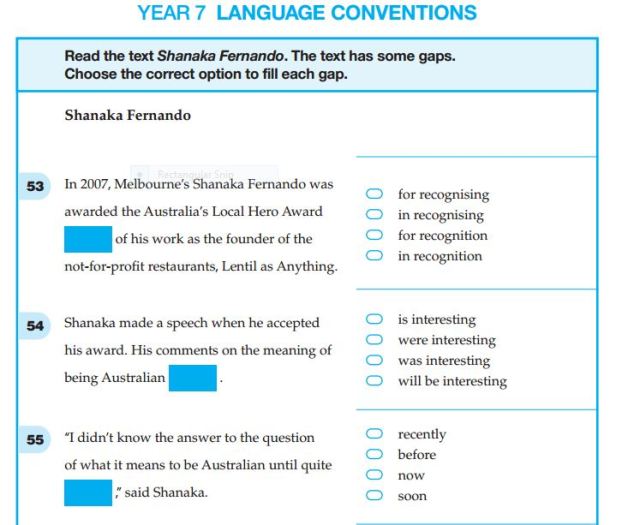
Where to start? The example test of course.

sentences

Answering the above questions correctly requires the student to apply a range of skills including: choosing the correct preposition, identifying the correct verb form; and, making sure the subject and verb agree. These last two (identifying the correct form of the verb and subject-verb agreement) have been covered in previous posts. Prepositions are covered below.

Prepositions

Prepositions are tough. They account for a large number of the common grammatical errors used by both native and non-native English speakers because there are no real rules that govern their use.

Academic English Online suggests the following strategies:

  • read a lot to internalise the correct associations,
  • use a dictionary with example sentences to find common associations; and,
  • memorise lists of words.

Note that: all of these strategies need to predate sitting down to the test (no, students are not allowed a dictionary in the test) so if you hear students misusing prepositions or read a mistake in their work, make sure you pass on this advice and then follow up with them to see if they need any further help.

Back

Posted in Grammar, NAPLAN, Punctuation | 1 Comment

Identify correct subject-verb agreement in a sentence

This post is part of a series relating to the Minimum Standards for Grammar and Punctuation in the NAPLAN tests. For the first post in this series, click here.

At Year 7 level, the students are expected to be able to:

  • identify correct subject-verb agreement in a sentence

Getting your subject to agree with your verb is easier than convincing a cat to lick itself.

© Dimitri Torterat, CC-by, www.adelieland.eu

© Dimitri Torterat, CC-by, http://www.adelieland.eu

This basically boils down to:

If the subject is singular (e.g. a bike), use a singular verb (e.g. is). If the subject is plural (e.g. some bikes), use a plural verb (e.g. are).

  • My bike is stored on my porch.
  • My bikes are stored on my porch.

There is a long list of qualifications and clarifications on this site here, which, with mastery, will put that internal monologue in your head about whether you should have said, ‘This tin of sardines is/are too much for my cat’ to sleep.

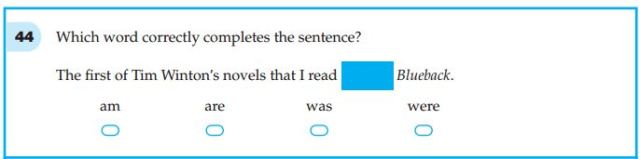
In their example test, the NAP go all out with this one:

NAP

The confusing part is that they have added tense into the equation. When we separate one from the other and only look at subject-verb agreement we just need to work out whether it is ‘was’ or ‘were’.

To do so you have to break it down. What is the subject? The first of Tim Winton’s novels. How many novels are they talking about? Just one. So, singular, ‘was’.

More help in regards to tense can be found in this post about identifying the correct form of the verb.

Back

Posted in Grammar, NAPLAN, Punctuation | 3 Comments

National Grammar Day (US)

I am a bit of a Johnny-come-lately to this one but yesterday in the United States was National Grammar Day!

March 4th has been celebrated as the day to celebrate grammar ever since the fun-lovers at the Society for the Promotion of Good Grammar deemed it thus in 2008.

Why?

According to abouttravelingtheworld.com:

“The National Grammar Day pays tribute to the syntax that result to perfect interaction among the people which is a critical element of peaceful associations.”

yes.

Posted in Grammar | Leave a comment

Identify the correct personal pronoun required to complete a sentence

This post is part of a series relating to the Minimum Standards for Grammar and Punctuation in the NAPLAN tests. For the first post in this series, click here.

At Year 7 level, the students are expected to be able to:

  • identify the correct personal pronoun required to complete a sentence

http://www.dailymotion.com/video/xtqs6q_best-quality-beatles-i-am-the-walrus-stereo-original-video_music

It came as some surprise to me when I learned (while at uni) that the use of ‘a’ instead of ‘an’ was governed by a fairly obvious and neat little rule.

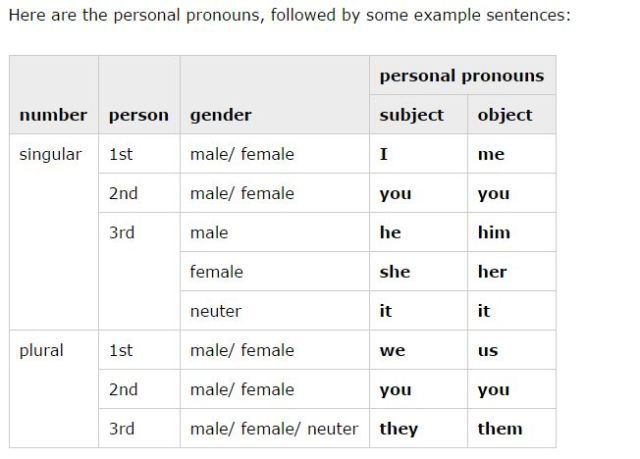
So I offer no judgement if you are realising for the first time that personal pronouns are dictated by: number, person, gender and case. At this level, it seems that NAPLAN are only interested in personal pronouns, not possessive pronouns – or any of the millions of other types of pronouns – so don’t worry about ‘our’, ‘his’, ‘her’ or ‘their’.

Personal pronouns are expressed in a neat little table that looks like the one below (from this website).

English Club - Personal Pronouns

This site also has example sentences that are not of the quality of, ‘The cockroach and the bird would get along very well without us, although the cockroach would miss us most’ but do illustrate the different applications of the pronouns nonetheless.

If you come across a student who is struggling with this, you can send them to this astonishingly boring ‘game’ here. If you find a better game, let me know.

Back

Posted in Grammar, NAPLAN, Punctuation | 1 Comment

Identify the correct form of the verb required to complete a complex sentence

This post is part of a series relating to the Minimum Standards for Grammar and Punctuation in the NAPLAN tests. For the first post in this series, click here.

At Year 7 level, the students are expected to be able to:

  • identify the correct form of the verb required to complete a complex sentence

A complex sentence has an independent clause and a dependent clause, such as, ‘Before the exam, Ethan will revise his notes’. For more examples (including the gem, ‘The cockroach and the bird would get along very well without us, although the cockroach would miss us most.’) click here.

In this case, the independent clause is ‘Ethan will revise his notes’ because it is a full sentence on its own. The dependent clause is, ‘Before the exam,’ because before the exam what!?

The verb we are talking about is ‘revise’, and, in this case, the tense is simple future so the verb is used in its infinitive (to revise). The internet is full of lists of verb forms like this one.

If you have grown up listening to English your whole life, the correct verb form will probably come easily. If you haven’t you will need a working understanding of the ways that different tenses influences verb forms.

Basically, if you find a student saying or writing something like, ‘…Ethan will revising his notes’, don’t let them get away with it. Providing them with the right verb will be helpful. Giving them encouragement for using a complex sentence and guiding them to more information on verb forms and tenses will be even more so. The more specific you can be about the nature of the error, the more likely your student will be able to fix it. For practice, you can send them here.

Back

Posted in Grammar, NAPLAN, Punctuation | 3 Comments

Grammar and punctuation

While our NAPLAN results have been on the up-and-up, there is always room for improvement. One area that we can work on is Grammar and Punctuation. While this can be a bit baffling for those outside of the English KLA, there are some simple conventions that can we can learn to give more targeted feedback to our kids.

What are they looking for?

The National Assessment Program (NAP) publish their minimum standards here. For grammar they outline a context and a task. In punctuation they identify a form of punctuation and specify a task that students should be able to do with it.

These standards are just an indication and don’t include all the concepts covered in the tests. if you haven’t seen one, it is helpful to have a look at the example tests published here.

Below are the standards. I have included some example sentences. Each week, I will look at one dot point. Follow the hyperlinks as they appear to detailed explanations of each standard, common mistakes and associated online tutorials.

Year 7

In grammar students can:

In punctuation students can:

In addition to this, students need to be able to correctly place a colon to indicate a list and correctly place an apostrophe to indicate possession.

Year 9

In grammar students can:

  • identify the tense of a short passage (The sample test that I read didn’t ask this but it did ask the students to complete a sentence using the correct tense, e.g. In order to be sustained, a rainforest requires rainfall of at least 1500 millimetres a year.)

In punctuation students can:

  • identify the purpose of italics in a sentence (e.g. I wasn’t the only one who was late to the movie.)
  • locate commas in a sentence to emphasise a clause (e.g. The student had been at the school for years, and not once had he come late.)
  • recognise that colons can be used to introduce lists (e.g. In your pencil case, you will need: a pencil, a pen, a ruler and an eraser.)

In addition to this, students need to be able to identify the correct form of contractions and identify the purpose of a hyphen.

Posted in Grammar, NAPLAN, Punctuation | 9 Comments

eBooks – Adobe’s Terms

Before you can use your netbook as an eReader, you will need to log in to Adobe and accept their terms and conditions.

1 Go to Adobe online.

2 Enter your username (username@hopcross.vic.edu.au) and your network password.

3 Check the box and accept the Terms and Conditions.

It’s your library.

Posted in eBooks | Leave a comment

Referencing

Referencing may be your last thought when you are conducting a research assignment (or ERA in psych) but it should really be your first.This is because, from the very first searches that you do in your assignment to the quotes that support your arguements, you should be acknowledging the source of your information.

From a more self-serving point of view, referencing is usually built into marking rubrics from Year 10 onwards so there are marks that are there for the taking. Good referencing, like correct spelling, is the cornerstone of good work. You also don’t have to worry about whether your teacher will ‘like’ your referencing because, like spelling, you either get it right or wrong. So get it right.

But it’s so confusing

No, it isn’t.

Alright then, how do I do it?

Your teachers will tell you the type of referencing they want you to use. This depends on the standard for the topic that you are taking. If they haven’t told you which one to use, ask.

To get the specifics of the particular styles, skip ahead in this post to the section called, ‘What are these styles of which you speak?’. To go straight to the guides on how to use some of the main styles, click here.

When conducting your initial searches, take notes as to where your information came from. You will need to know the author, editor (if there is one), year of publication, title, edition, publisher and the place of publication. There are different requirements for newspapers, journals and websites so make sure you find out the referencing style beforehand and take note of the required information while you are doing your research.

If you are mainly conducting your research on the web, use an online bookmarking site like Delicious or Pinterest to keep track of the websites you visit.

In text or at the end

When you use a quote or refer to an idea in your essay you will usually need to reference it in the text and include it in your bibliography. On the other hand, if you have used someone else’s work to get background information on your subject, it will need to be acknowledged in the bibliography at the end (this also shows the teacher how hard you worked to research your assignment so make sure that it is impressive). Once again, the format of this depends on the referencing style that you are using so make sure you know which one to follow.

Acknowledging quotes and ideas in your assignment will either be done using an in text citation if you are using the Harvard style or in a footnote if you are using the Oxford referencing style.

In text references (Harvard) will need the last name, date and a page number. To use an author’s ideas, just put his or her name and the date then explain the idea in your own words, for example, ‘Cox (1996) suggests that…’. When you are quoting the author, include the page number and then the quote in quotation marks, ‘Cox (1996, p.17) writes “Camels are…well suited to the hot dry (desert) climate”,..’. Make sure that you only quote the information that is relevant and use ellipses for omissions (…) and parentheses for your own additions (()).

Footnotes (Oxford) involve a number in the text in supertext (ctrl+equals). That relates to a footnote at the bottom of the page that includes the author (first name first, eg. T. Flannery), editor, year of publication, title, edition, publisher and the place of publication. The exact information you need and the order that this should be in depends on the type of source that it is (book, encyclopedia, website, etc.).

Your bibliography then includes all of the details of the sources that you quoted as well as any other sources that you used to create your piece. This is where you create a list, organised alphabetically, that includes the author (last name first this time, eg. Flannery, T), editor, year of publication, title, edition, publisher and the place of publication. Once again, the order of this information depends on the type of source and the style of referencing you are using.

What are these styles of which you speak?

Some subjects prefer you to use the American Psychiatric Association‘s referencing style (APA), others will prefer the Harvard or Oxford styles. MS Word has a button on the Referencing tab that will generate citations for you in a range of styles (pictured below). Other style guide are available free online, like these provided by Victoria University, which will tell you how to format your references in the relevant style.
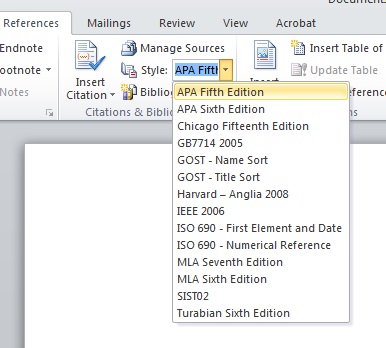
MS Word Referencing

I don’t really want to do any work, can someone do it for me?

Yes. As you can see above, MS Word has a button that will generate citations for you. Just select the style that you are using and a window will pop up with a form. Fill out the form and it will format that information into a perfectly formatted citation for you.
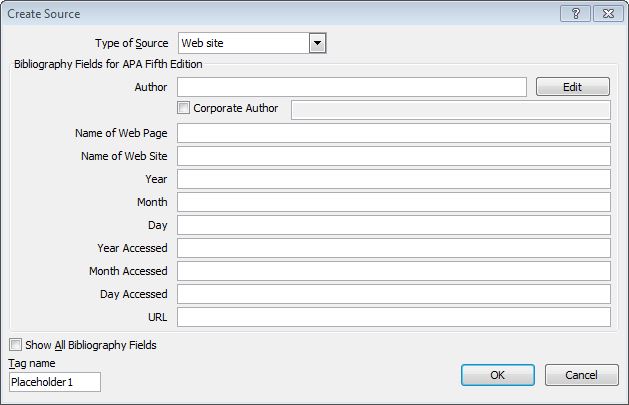
MS Word Referencing

A final note on Plagiarism

Plagiarism is the best way to get no marks for an assignment that you have worked moderately hard on. Zero. If you put in just a little bit more effort and reference your sources properly you will end up with excellent marks. Moderate effort and no marks or a little bit more effort and great marks, I know what I’d be doing.

Having trouble referencing? Come and see us. It’s your library.

Posted in Research Skills | Leave a comment