Come Down, Cat! | Review | CBCA BotY 2012

Sonya Hartnett has written some terrific stuff over the years and it is easy to see how she has the following that she does (and is shortlisted as often as she is). Come down, cat! shows her versatility in being able to create books for every audience. The story is a very simple exploration of the way that fear is a very personal thing, that bravery comes not from not being scared but in the overcoming of fears. And that cats are selfish.
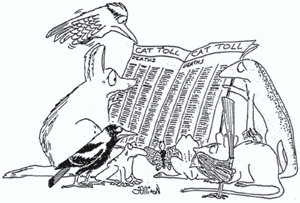
The book introduces Nicholas who is worse than the Nazis because he allows his cat out of the house. Nicholas is afraid of the dark, he has a cat who is up on the roof and is afraid of the rain, night is falling and a storm is coming in. Can you see where this is going?

The story is perfectly written. The dialogue between the cat and Nicholas is witty and the descriptive language that Hartnett uses is evocative and spooky. We really get in touch with the characters in this story.

The illustrations in the book add a third dimension to the text. The drawings are so dynamic that it feels like you are seeing this book rather than reading it. As the story plays out we hear the creaking of the ladder, feel the wind around us and experience the great height of the roof. Lucia Marsciullo introduces a new and unspoken fear that is so powerful it left my hands sweating.

Just as Nicholas is not afraid of the rain and the cat is not afraid of the dark, neither of the characters is particularly bothered by the height of the roof. But I am. Nicholas braves actual danger and irrational fear in the story, the cat just hangs out in the dark. Readers can take comfort when relating this book to their lives that others may not find what they find scary scary (yeah, that’s how I’m chosing to say that). Alternatively they may be inspired by Nicholas and his ability to overcome his fear. Furthermore, they may be discouraged from letting their cats outside. Win, win, win.
Posted in BotY, CBCA, Shortlist 2012 | 1 Comment

Ishmael and the Hoops of Steel | Review | CBCA BotY 2012

It took me a while to shake off the cravings from my Brotherband experience. For the first few chapters of Ishmael I just found myself wishing they would take to the sea in some inventively designed boat and fight some pirates. The nerds won me over though and eventually I resolved myself to the fact that swords had been replaced by mathematics.

For those who know the rules of the Award (specifically 1.3.1 Note iii), you will be familiar with the condition that for series books to be included in this award, they need to be able to stand alone. I tested this by skipping the second book and found that I really hadn’t missed anything. There are a few references to Ishmael’s dad’s band but these were fairly well explained. I am not sure if I would have had the same experience if I hadn’t read any of the Ishmael books but seriously, if you haven’t read any of the Ishmael books, what are you doing with your life?

This edition follows the boys as they finish their final years of high school. The drama is based around whether they can win the coveted College Cup for their beloved teacher – Ms Tarango. It is a gentle story and one that is about as far from murder on the high seas as Ophelia is from happiness.

This is one of the great virtues of the Ishmael stories, they don’t resort to violence to solve the problems. In the novels the teenagers are essentially like teenagers are – nice. Take this anecdote for example: two of the main characters, Ishmael and Razz, unwittingly end up with video footage of one of their peers undressing. One of the characters wants to watch it, the other puts forward the case that, if you find yourself with a digital image (photo or video) of someone, you need to first consider what they would want you to do with it. You could base a whole cybersafety on this incident as Bauer raises the bar of acceptable behaviour – teenagers need to be confronted by the concept that if this is how people should behave when they get this sort of footage by accident, then maybe it is really wrong for them to be taking a photos up girl’s skirts and putting them on their facebook pages.

That being said, these kids are pretty puritanical. Either the characters in this story are inauthentic or they inhabit a different planet to those created by authors like Phillip Gwynn and Scot Gardner. I just couldn’t get over how nerdy these kids were. I know that they are meant to be nerdy but they act less like nerdy teenagers and more like fairly daggy dads.

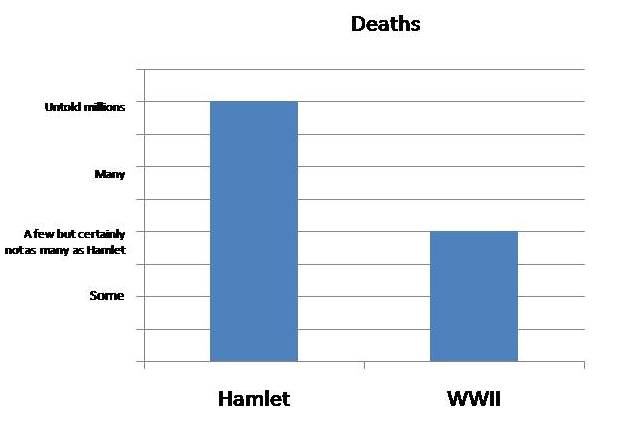
This books wraps up all of the loose ends in the books and, like final episodes and reunion shows, everyone is a bit too interested in loving themselves and each other to do things properly. Hoops of steel lacks flow and direction and it is hard not to stop half way through and ask ‘where is this going?’. It also underuses the extended metaphor that is going on with the play Hamlet. More people are killed in the final act of Hamlet than were killed during the entire second world war (see chart) and not a single person is killed in this book. I know that I was praising the lack of violence at the start of this review but hey, people are complicated and I guess I am just trying to say something about the duality of man (language warning on this link).

Before this review becomes as lacklustre as the Hoops itself I will conclude it here: this is essential reading for Ishmael fans, this is a nice, funny book for everyone else. That is all.

Posted in BotY, CBCA, Shortlist 2012 | 1 Comment

The Runaway Hug | Review | CBCA BotY 2012

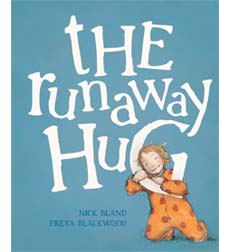
Not what I expected from Nick Bland and Freya Blackwood. The runaway hug is an extremely cute book about a girl who is given her mother’s very last hug. Nick Bland of The very cranky bear franchise usually writes funny rhyming stories about bears. In this book he has teamed up with Freya Blackwood of the North Fitzroy bob, layered garments and striped tights fame who normally illustrates books about girls with bobs, layered clothing and stripey tights. The reason that this is such a surprise as a book is that this book falls squarely into the category of the latter.

As a result, the book has a very different sense of humour than expected. Obviously the idea that a hug can run out is a very funny one and obviously the earnestness with which the girl undertakes her role as custodian of the last hug is also very funny. The illustrations are funny too. There is a scene where the dad just throws his hands up in the air in celebration of the hug he has just received (ok, he is probably gesturing at the TV but it is funny to imagine that it is about the hug). But overall it is nowhere near as funny as The very cranky bear.

The illustrations themselves are totally awesome. Blackwood has an ability to zoom and pan and show texture and warmth and the love that is in this chaotic family home. She encapsulates the bedtime ritual and emotionally purveys the devastation of losing the hug. She also plays off the incompleteness of her drawing, all guide lines and first and second attempts, aqainst a minute level of detail evident in the carefully selected contextual articles that give the book its authenticity (the peg ears on the toy zebra, for example).

The runaway hug is a book that says, ‘Watch out, kids sometimes take things too literally!’ It does so in a beautiful and mildly comical manner. Readers who expect something more bazaar or droll will be disappointed but those looking for a sweet little story about hugs and family will be well rewarded.

Posted in BotY, CBCA, Shortlist 2012 | 4 Comments

No Bears | Review | CBCA BotY 2012

Postmodernism in picture story books is such a common thing that it even has its own wikipedia page. According to the page, No bears fits into the category of ‘books that are aware of themselves’. While some books that are self-aware are awful, this one is loads of fun.

Meg McKinlay has done a fantastic job of conjuring up a bossy little girl who is sick of books about bears and determined (since she is in charge) to create a bearless book. This is hilarious on a number of levels. Firstly you can’t say ‘there are no bears in this book’ without saying the word bears. The very statement conjures the thing into existence. I am sure there is a name for this concept but I can’t find it. I did in the process find out that you can prove a negative (check out the caption below the picture) and that, according to Gamp’s Law, you can’t conjure food. Secondly, there is quite obviously a bear on every page and thirdly, the bear is not only the book’s hero but also very gracious about it despite the little girls ignorant jibes.

On a side note, if you are reading other reviews of this book – and the internet has plenty – you might feel the urge to write in a good-natured way and tell the author that they are out of their mind and the girl in the book is actually called Prue and why do you keep referring to her as Ella? I would resist that urge because, unless they are all suffering from some collective dilusion, it seems that the weight of evidence that she might be called another name in a parallel edition of this book is pretty convincing. Why don’t the American’s get the name Prue? It’s a cool name.

The illustrations by Liela Rudge (the other half of the old team that did Duck for a day, but I would keep that on the down-low) are a bit Oliver Jeffers. Anyone who knows my sycophantic devotion to Jeffers will know that that is code for ‘ace’. The jaunty fonting and word position add to the effortless casualness of this book – some books try to hard and it’s obvious, some don’t try hard enough (although thanks to the discerning nature of publishers and the good people at the CBCA, teacher librarians like myself aren’t put through them that often) this book is spot on. Giving kids a taste of postmodernism at a young age is an excellent idea. The world is a really wierd place, let them know it early.

Posted in BotY, CBCA, Shortlist 2012 | 3 Comments

Outcasts | Review | CBCA BotY 2012

Like Mills and Boon (I hear), John Flanagan writes really addictive stuff. I don’t mean can’t-stop-digging-into-the-leftover-cheesecake-in-the-fridge type addiction, I mean put-on-a-high-vis-vest, drop-by-the-local-retirement-home, borrow-their-flatsceen-and-haul-it-down-to-Cash-Converters-so-that-you-can-pick-up-his-latest-novel-from-the-enterprising-self-starter-on-the-cnr-of-Russell-and-Bourke-streets. Also like Mills and Boon, we aren’t reading it for the quality of the writing.

Outcasts is the first book in a new series titled Brotherband (the second of which, The invaders, is already out in shops). Book one follows a group of outsiders as they form their own ‘brotherband’ because they are too short-sighted, short-tempered or short on testosterone to become part of one of the other brotherbands. I don’t know if brotherband is a terrible translation or just a terrible name but this is not all that is terrible about the writing.

Flanagan sells so many books that my criticism is irrelevant (and, as I may have mentioned earlier, his books are awfully addictive) but he seems to need a lesson in show don’t tell. In the opening, for example, he introduces the characters Mikkel and Thorn by describing them thusly: ‘Mikkel was taller and leaner than the average Skandian. But he was powerful and hard muscled. And he had the reflexes of a cat…Thorn was slightly shorter than his friend, but much wider in the shoulders and chest.’ Surely Flanagan could have come up with some sort of event that would neatly display these qualities rather than just hitting us in the face with them. I would have been rolling my eyes but I couldn’t tear them away from the page.

The reason that this book is so addictive is that it is packed full of adventure and has a great cast of characters that fit into the ‘he’s a loser like me and he is winning at something’ mould. That and there is one of those awesome, rough, ex-drunk mentor characters.

The brotherbands are in training to become the next group of Skandian raiders. Because the main character Hal’s brotherband is made up of nerds, this becomes a bit of a David and Goliath story. They compete in various tasks like running up hills, running around town and sailing places in a book-long training sequence that puts JCVD to shame. I would like to say there was more to it than that but really, that’s pretty much it.

Ethically this is a fairly compromised book. The solution to all the problems is usually violence and for some reasons the Vikings take the moral high ground over the Magyarans (for some reason, saying that all Hungarians are thieves would, appropriately, make everyone mad but calling all Magyarans pirates is ok). The CBCA also says that books that are part of a series that get shortlisted need to be able to stand alone but this obviously doesn’t appear to apply to books that don’t have a proper ending.

Due to these problems, Brotherband will not win the book of the year award but that doesn’t make it any less readable. Indulge a guilty pleasure and get into it.

Posted in BotY, CBCA, Shortlist 2012 | 2 Comments

One Small Island | Review | CBCA shortlist 2012

Macquarie Island has had a bit of a rubbish time of late. First the sealers came and killed all the seals, then, when they ran out of seals, they introduced rabbits so that they would have something to eat while they practiced their ‘cruelty’ on penguins (considering the way that animals were treated acceptably in the 1800s it boggles the mind to think what one would describe as cruel back then…). The result to the island was devastating. Alison Lester manages to pull together a good news story out of conservation efforts that have been going on in recent times to return it to some of its former glory.

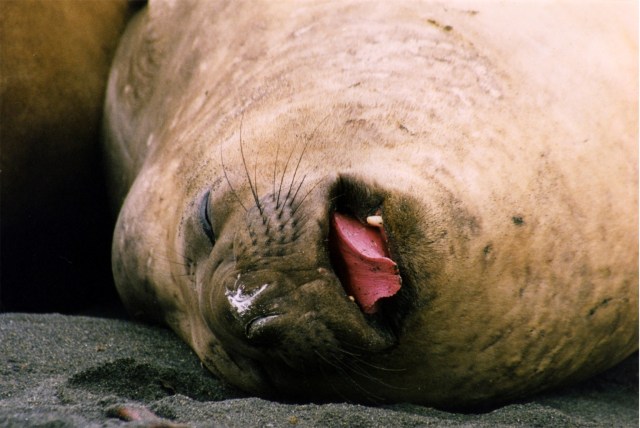
Southern Elephant Seal at Macquarie Island – photo by Brocken Inaglory

The book’s cover with its captivating illustration of the Southern Aurora draws us in to this richly decorated resource. The story is told through a narrative in simple type that runs across the tops and bottoms of the pages and there is a great deal more material presented in the resources imbedded within the illustrations. If you want the bread and butter story you can follow the type but subsequent viewings will teach you more and more about the island and its inhabitants.

Readers will note that a great deal of care has gone into the elements that create this work from the selection of the subject to the thoughtful and beautiful presentation of supplementary material. Macquarie Island is a great microcosm for the challenges facing those looking to restore environments to their former glory and the lessons from there are obviously applicable to larger and more complex areas such as the great big island on which we live.

Posted in BotY, CBCA, Shortlist 2012 | Leave a comment

Rudie Nudie | Review | CBCA Shortlist 2012

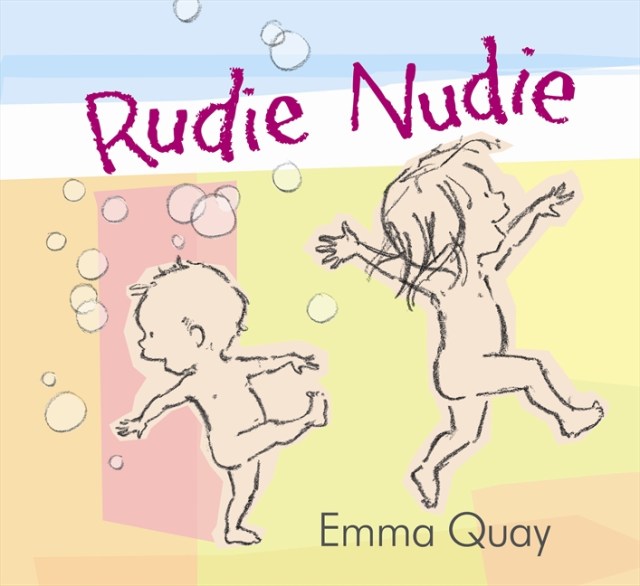
To get a good relationship between text and illustrations they don’t have to be done by the same person but it helps. Emma Quay has done a great of of capturing the bathtime to bedtime ritual in a way that is joyful and lyrical.

The writing in Rudie nudie is sparing and the illustrations are simple. The abcb rhyming scheme provides an excellent build-up – the seemingly unrelated first three lines are all tied up by the fourth. The irregular cadance throughout the story further adds to this giving the poem a level of frivolity accentuated by the onomatopoeic language. We see, read and feel the bath, the bubbles, the air on our skin and the mat under our feet.

All of this, of course, ignores the real point of the book – how fun it is to run around naked after a bath especially while the glow that the hot water has imparted to us radiates from within. We see the children enjoying the visceral pleasures offered by various surfaces and textures around the house and then brave the backyard before they are called in to get tucked in to bed. I am sure that one very big selling point of this book is how much parents and other hangers-on, such as librarians, who read these books just want to do what the kids are doing.

Posted in BotY, CBCA, Shortlist 2012 | 1 Comment

The story so far – CBCA Shortlist 2012

For the past few months I have been reviewing books shortlisted by the Children’s Book Council of Australia for their Book of the Year award. The award goes to the best book in the Older Readers, Younger Readers, Picture Book and Early Childhood categories (and the Eve Parnell award for non-fiction that I haven’t looked at).

Books shortlisted for the Older Readers category are suitable for mature readers who are usually in middle to upper secondary school. Books in the Younger Readers should suit upper primary to lower secondary students who can read independently. The Picture Book category contains books that may be appropriate for any age (but not necessarily appropriate for all ages) from birth to 18. Finally, the Early Childhood category covers books for kids who are pre-reading or have just started reading.

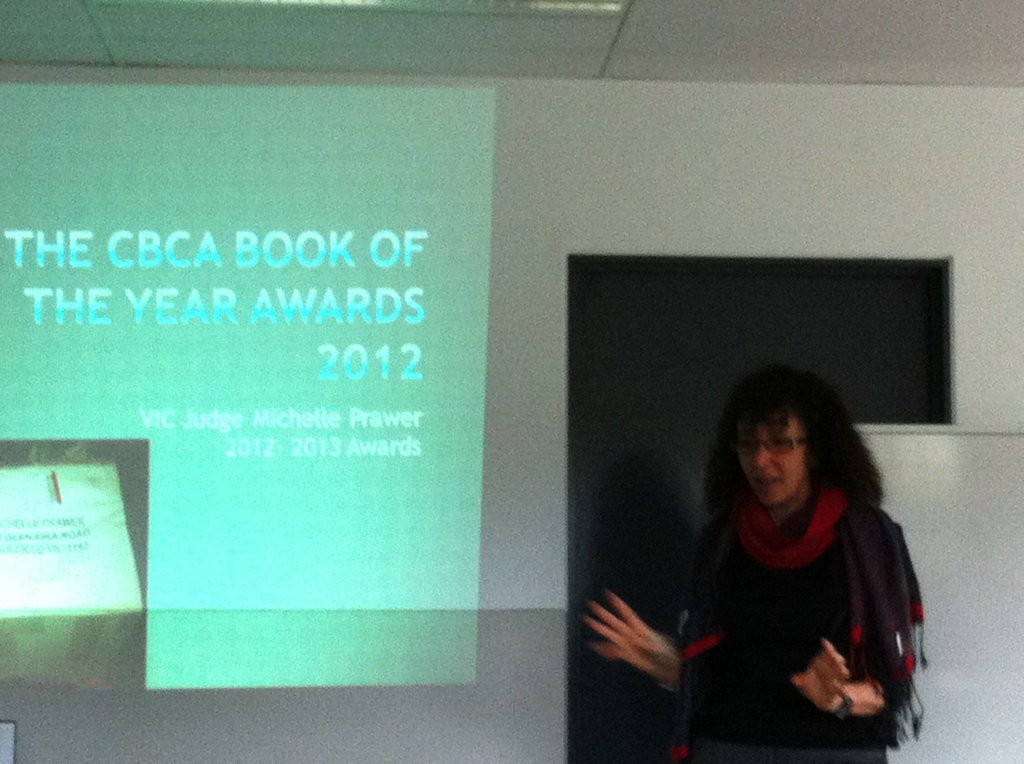
CBCA Victorian Judge - Michelle Prawer

CBCA Victorian Judge Michelle Prawer talking at St Mary’s Primary School, Hamilton.

The shortlist and winners are chosen on literary merit by a panel of judges who have to be financially disinterested yet knowledgable about children’s literature and have a lot of free time (they don’t get paid and they read between 350-400 books per year for the two years that they are judges). They are heroes. I saw the Victorian judge – Michelle Prawer – speak recently and she is not only all of the things above, but also an amazing presenter. Here are the books…

Older Readers

A straight line to my heart (review) – Bill Condon

Ishmael and the hoops of steel (review) – Michael Gerard Bauer

Ship kings: the coming of the whirlpool (review) – Andrew McGahan

The dead I know (review) – Scot Gardner

The golden day (review) – Ursula Dubosarsky

When we were two (review) – Robert Newton

Younger Readers

Brotherband: the outcasts (review) – John Flanagan

Bungawitta (review) – Emily Rodda (ill. Craig Smith)

Crow country (review) – Kate Constable

Nanberry: black brother white  (review) – Jackie French

The golden door (review) – Emily Rodda

The truth about Verity Sparks (review) – Susan Green

Picture Books

A bus called heaven (review) – Bob Graham

Flood (review) – Jackie French (ill. Bruce Whatley)

For all creatures (review) – Glenda Millard (ill. Rebecca Cool)

Look, a book (review) – Libby Gleeson (ill. Freya Blackwood)

No Bears (review) – Meg McKinley (ill. Leila Rudge)

The dream of the thylacine – Margaret Wild (ill. Ron Brooks)

Early Childhood

Come down, cat! (review) – Sonia Hartnett (ill. Lucia Masciullo)

No Bears (review)- Meg McKinley (ill. Leila Rudge)

Rudie Nudie (review)- Emma Quay

That’s not a daffodil! – Elizabeth Honey

The last Viking (review) – Norman Jorgensen (ill. James Foley)

The runaway hug (review)- Nick Bland (ill. Freya Blackwood)

Posted in BotY, CBCA, Shortlist 2012 | Leave a comment

A Straight Line to My Heart – CBCA Boty 2012

I just can’t tell how I feel about this book. Maybe it’s because I started reading it on my phone and didn’t get a proper sense of the intended audience. In any case I felt that the characters lacked development, their treatment by Condon was patronising, I couldn’t identify with the setting and the plot was overly driven by conversation. Then, about three-quarters in, I found myself really looking forward to picking it up again and, in rereading some parts of it in order to write this review, I was struck by how ungenerous my first impressions were.

I’m not the only one who was perplexed by this book, the ladies at Young Adult Anonymous found it a bit perplexing too. Not in an every-character-in-this-book-has-a-Swedish-name-starting-with-the-letter-‘b’ type of way but just a little bit confused by the packaging. And it is confusing. So is the introduction.

This book has an annoying start. Tiff is supposed to be some sort of intellectual but the tone of the book is so down-to-earth as to be practically subterranean. A burst of self-loathing sees her destroy poor Mrs Muir’s sunflowers because of the way that she reacted to a boy in the library. Oh, so this is one of those unbearable love stories, you think. Then she returns home to find some old guy who lives at her house (stepfather?) obviously dying of cancer but maintaining a stiff upper lip. Oh, so this is one of those tragic family stories, you think. But it is kind of neither.

A straight line to my heart is like listening in to someone’s conversation on the train – at the start of the journey you are a bit annoyed by how loud they are talking, a few stations in you have started to take sides in their story then, and then, when you walk from the train to the tram stop you strategically position yourself next to them so that you can hear how it ends.

The story is developed in the same way. Condon really knows his characters and at first you are totally at sea as to who is who. Eventually you lose hope of trying to work it out and just ride the wave as it approaches the treacherous rocks on the headland. Here is what I got from it:

The main character, Tiff, lives with her father, Bull, or maybe he is her brother or something. I get the distinct feeling that he is in some way related to Regie (who also lives in the house) but I can’t tell if Bull is middle-aged and therefore his son or younger and maybe not his son. They do in any case all reside under the same roof and Regie seems to be the Padre de Familia (although, since he has some terrible disease, maybe he is the Grandpadre de Familia or maybe, since he lives in the country he isn’t that old at all and is just suffering from the great burden of disease enjoyed by those who live away from the city). I won’t even begin to go into the family tree of Tiff’s friend Kayla but let’s just say that Condon has on no way scrimped in our helping of unconventional homes.

Being a through-and-through city-slicker I am totally prejudiced against the small-town setting of this book. Because they are all playing rugby and bashing each other up and working on cars and hanging out in cemeteries I am, like, why is this book so shallow, why don’t the characters have any depth, where in this small hamlet can I pretend to find a latte in a rustic cafe with local artworks on the wall? But I worked through it and by the end I was distinctly enjoying how bogan it all was.

Condon has managed to create a real creeper of a book that will reward a good read or possibly two. It is not obvious, the writing is occasionally very cliché (but hey, so are teenagers) and the whole thing is very colloquial. These left me with really mixed feelings about the book. Mixed feelings are good.

Posted in BotY, CBCA, Shortlist 2012 | 1 Comment

Flood | Review | CBCA Shortlist 2012

When Lisa Simpson tells Homer that the Chinese have the same word for ‘crisis’ as they do for ‘opportunity’ she is half right – according to the people at the internet, they do share a character. Whether that is like saying that we have the same words for ‘Bruce Whatley’ as we do for ‘what a painter!’ is one for the linguists but this book is certainly about crisitunity.

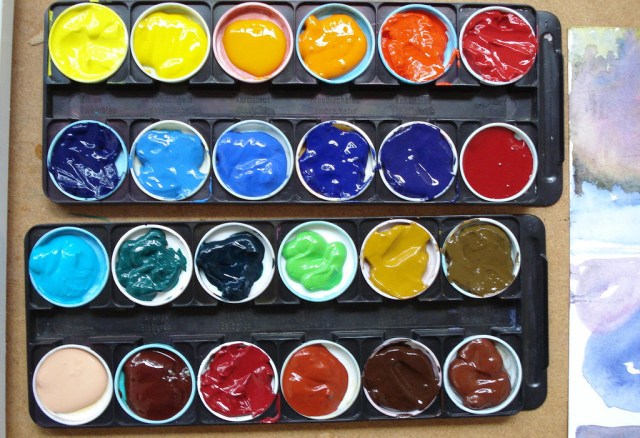
New watercolour palette selection - DailyPic

The BotY is always good for a bit of disaster porn and this year is no different. We have drought with the fun Bungawitta and we have downpour with the sodden, Flood. The book is a narrative without a protagonist. And, while we have a narrator telling the story, it is the pictures that do all the work.

Every page is an artwork in this visceral piece on the recent floods in Queensland. The images tell the story of the downpour, the devastation and the aftermath. Their articulate composition explains the magnitude of the event and the individual’s responses to it. We are Hansel and Gretled through the tale by the mute presence of the dog silently observing the work of the locals as they stoically deal with the sudden downpour. He (or she) is a great symbol of the passive observer, nature, as it watches us go about our toils at once in need of protection and totally in control.

There is a political message to this story too – why build things on an area that is known to be a flood plain? But it is hidden in the information for the adults. Kids, on the other hand, get a patriotic chest beating story about how heroic people were chipping in. There is certainly bravery in the story of the tug boat going out to guide the dislodged bridge and protect the town. The rest of the story though is related adequately through the pictures making the text jingoistic and unnecessary.

Whatley, we are told, normally does funny stuff and works with his left hand when he wants to engage his emotional cortex. It works terrifically. The pages are so waterlogged that you feel you could ring this book out. The writing is soggy too but in a different way. Reading this book with your hand over the text is one of the best picture story book experiences that you can have – just be careful not to drip on the carpet.

Posted in BotY, CBCA, Shortlist 2012 | 1 Comment